On a single R1 lot in the City of Los Angeles, with no lot split, you can build a four-unit project two ways. The key lever is height: main dwelling units (and an attached ADU riding one) get full R1 height, about 28 to 33 ft; detached ADUs are capped at 16 to 20 ft.
FAR and RFAR: we use the two interchangeably on this page. To be exact, the City of Los Angeles's term for the residential floor-area limit is RFAR (Residential Floor Area Ratio, LAMC 12.03) — that is the 0.45 and the variation-zone numbers here. State law uses the broader FAR (Floor Area Ratio). For these lots they mean the same budget.
- 2 units at full height (the duplex); the two back ADUs at 16–20 ft
- The duplex makes the lot multifamily, so the two back ADUs carry no FAR limit
- Best for maximum footprint
- 3 units at full height (two main dwellings + the attached ADU); one detached ADU at 16–20 ft
- FAR-bound; an R1V2 variation zone gives more budget
- Best for maximum full-height space
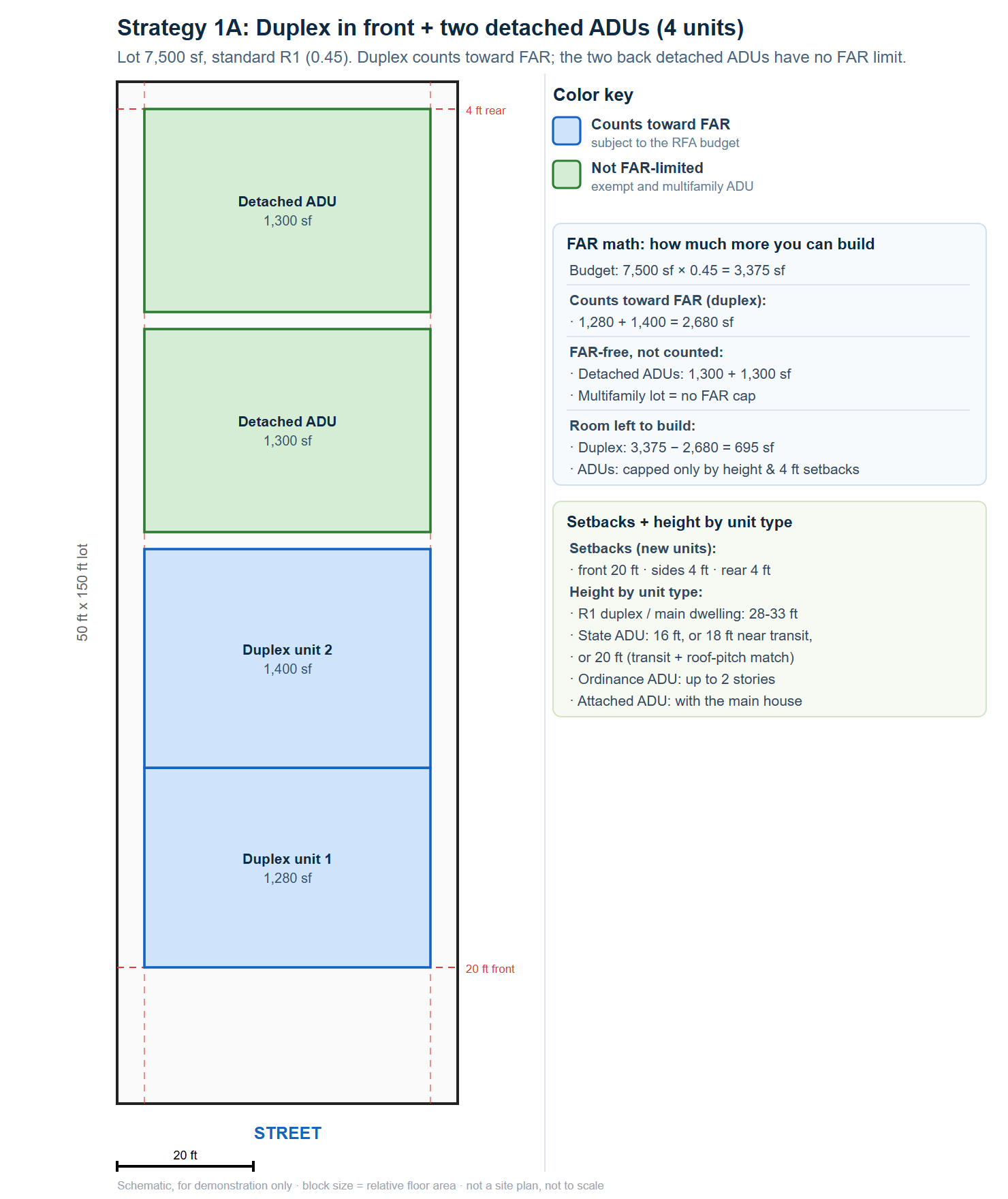
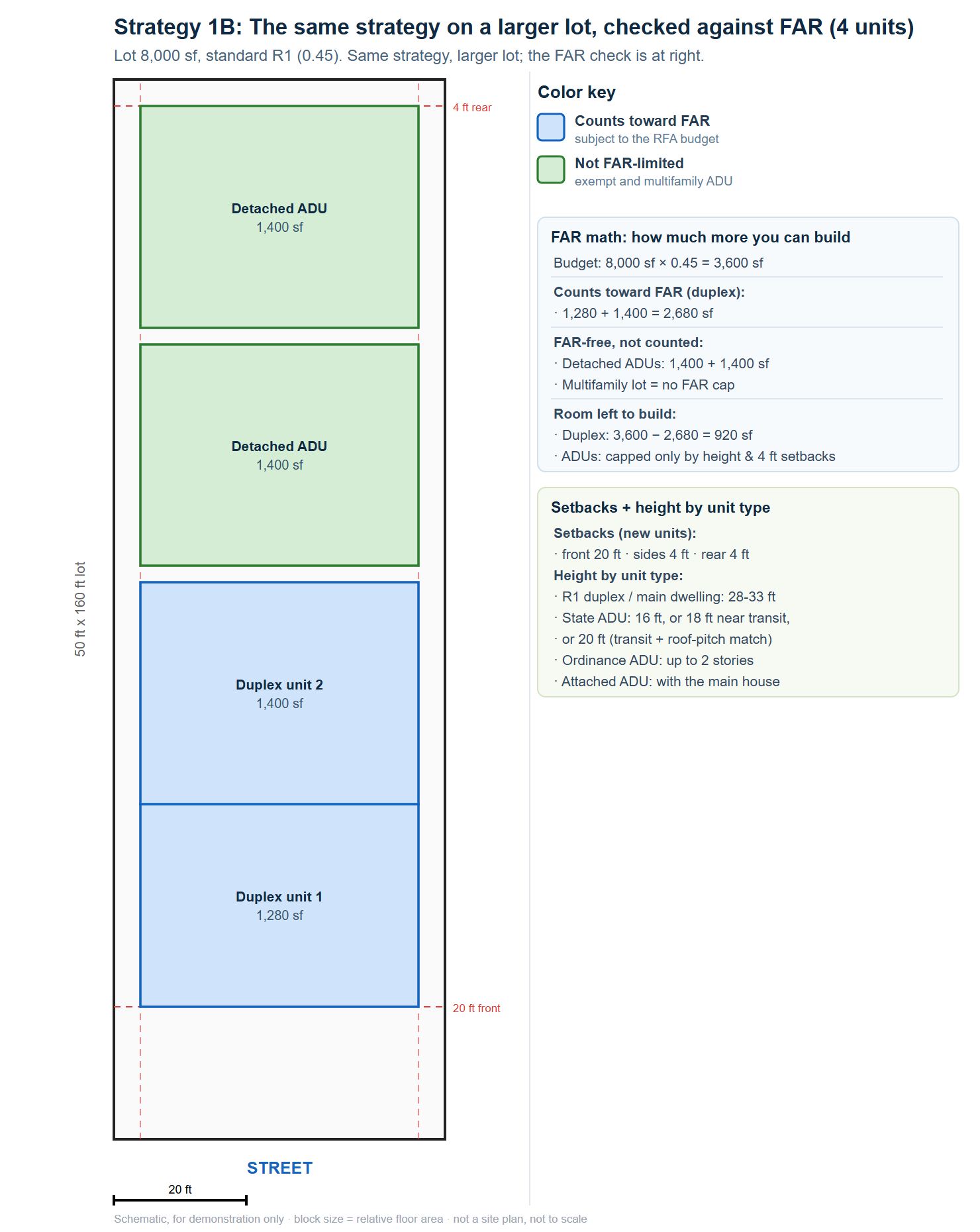
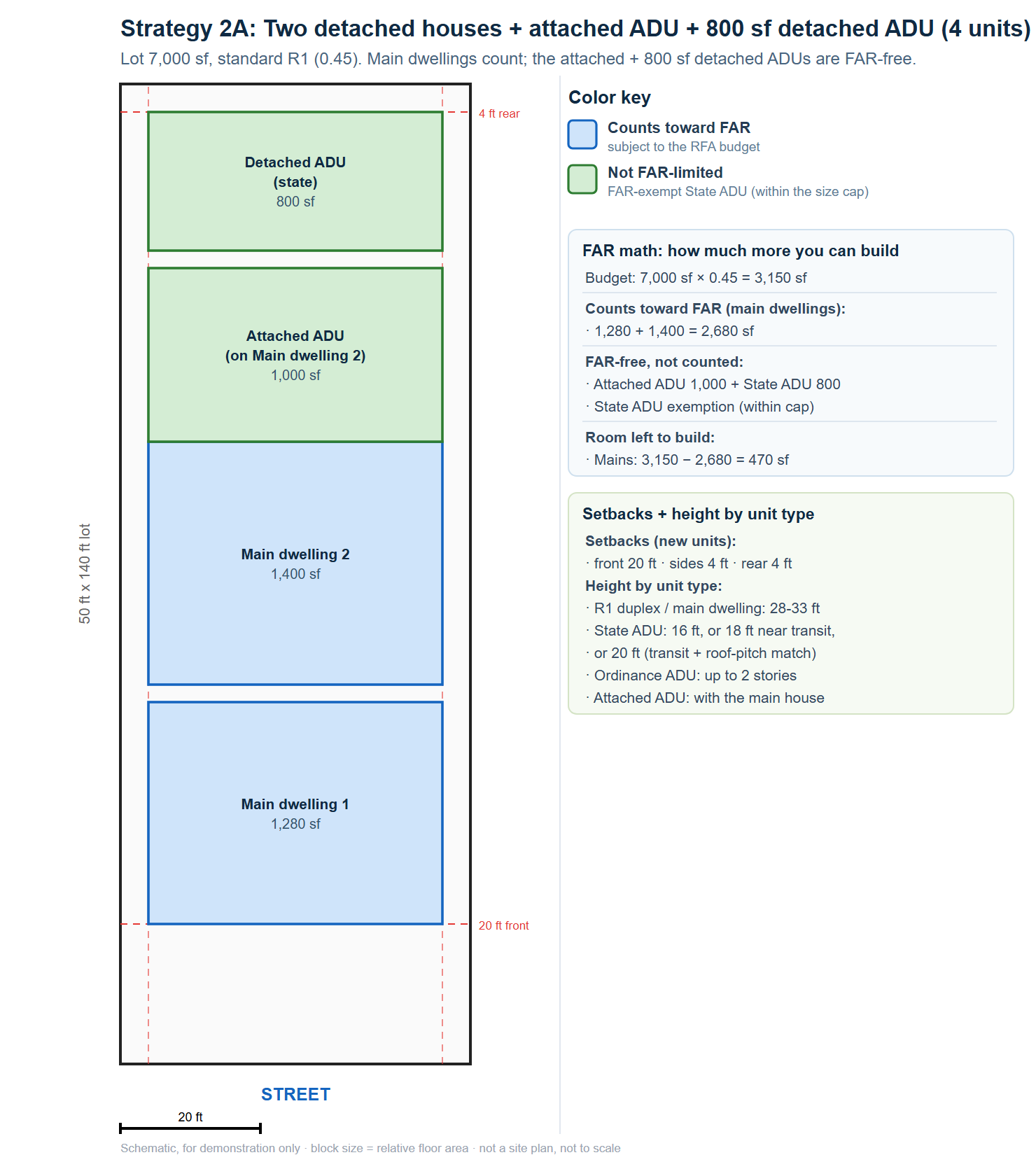
The diagrams below are schematic, for demonstration only: each block's size shows that unit's relative floor area, so a larger unit reads larger. They are not buildable site plans and are not to scale.
1. The unit types you can use
Two are full homes (primary dwellings), the rest are accessory units (ADUs / JADU). The column that decides everything is does it count toward floor area (FAR)?
| Unit type | Authorizing law | Max size | Counts toward FAR? | Height | Side/rear setbacks | Parking |
|---|---|---|---|---|---|---|
| Existing or new main dwelling unit — keep the existing house, or build new | LAMC R1 | per RFAR budget | Yes | existing, or R1 28–33 ft if rebuilt | existing, or 4 ft if rebuilt | existing |
| SB9 second main dwelling | GC 65852.21 | at least 800 sf guaranteed; otherwise per RFAR | Yes | R1, about 28–33 ft (2 stories) | 4 ft | 1, or 0 near transit |
| Duplex: two attached front main dwelling units | SB9 two-unit development | per RFAR budget | Yes (both units) | R1, about 28–33 ft | 4 ft | 1/unit, 0 near transit |
| Detached State ADU (single-family lot) | GC 66323(a)(2) | 800 sf | No (FAR-free) | 16 ft; 18 ft near transit; 20 ft if transit + roof pitch matches | 4 ft | 0 |
| Detached State ADUs (multifamily lot, e.g. behind a duplex) | GC 66323(a)(4) | no SF limit | No (not subject to FAR) | 16 ft; 18 ft near transit or multistory MFD; 20 ft if transit + roof pitch matches | 4 ft | 0 |
| Attached ADU (can attach to either main dwelling) | GC 66323(a)(1) / LAMC 12.22 A.33(c),(e) | 850 sf (1 bed) / 1,000 sf (2+ bed) | No, up to that size | shares its main house's height (built as part of it) | with the house | 0 |
| Detached Ordinance ADU | LAMC 12.22 A.33(b)(1) | 1,200 sf | Yes — the whole ADU | up to 2 stories (zoning height limit) | 4 ft | may be required |
| JADU not used here | GC 66333 | 500 sf | No (carved inside the house) | within the house | n/a | 0; owner-occupancy required |
Number allowed (no lot split): SB9 gives up to two primary dwellings. A duplex (multifamily) allows up to two detached State ADUs. Two detached houses (single-family) allow one attached ADU + one detached ADU + one JADU.
2. The floor-area (FAR) rules
Your floor-area budget is lot area × RFAR (standard R1 is 0.45, so a 7,500 sf lot allows 3,375 sf). Whether a unit draws from that budget is the whole game.
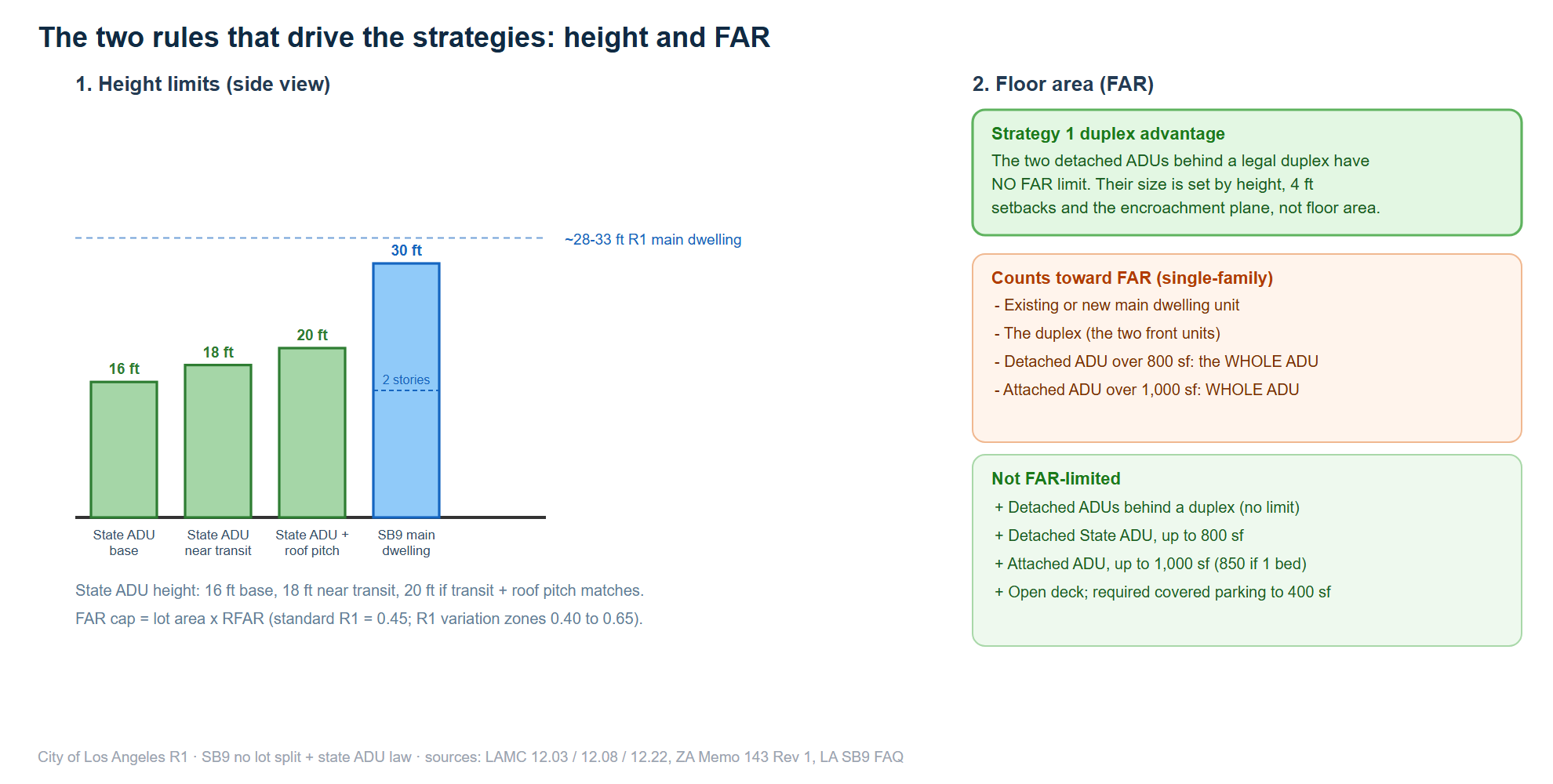
Source: LAMC 12.03 (Residential Floor Area), ZA Memo No. 143 Q.3 (“RFA may not be enforced on State ADUs, nor to the extent they prevent the minimum sizes allowed for detached (800 sq. ft.) and attached (850 and 1,000 sq. ft.)”).
3. State ADU height: 16, 18, or 20 ft
A detached State ADU height depends on transit proximity and roof pitch (ZA Memo 143, Q.38):
- 16 ft — the base height, not near transit.
- 18 ft — if the lot is within a half mile of a major transit stop or high-quality transit corridor (or, on a multifamily lot, if the main use is a multifamily, multistory dwelling).
- 20 ft — the 18 ft plus an extra 2 ft, allowed only when the ADU is near transit and its roof pitch aligns with the primary dwelling.
The 20 ft is not a free upgrade: it requires both the transit location and the matching roof pitch. By contrast, a detached Ordinance ADU can go up to two stories (the zoning height limit), and the SB9 main dwellings follow R1 height, roughly 28 to 33 ft.
4. The two SB9 + ADU combinations
ZA Memo 143 spells out two ways to combine the SB9 two-unit development with ADUs on a lot that is not split. Our two strategies map onto these directly:
Path A — a duplex (the two units are attached)
A two-unit development built as a duplex makes the lot multifamily, which allows up to two detached State ADUs (GC 66323(a)(4), no size limit, not FAR-limited). This is Strategy 1.
Path B — two detached one-family dwellings
Two detached houses (an existing or new main dwelling plus a second main dwelling) use the single-family ADU menu: one attached ADU, one detached ADU, and one JADU. This is Strategy 2 (we use the attached ADU + detached ADU; the JADU is available but adds an owner-occupancy requirement, so we leave it out).
5. Strategy 1: Duplex in front, two ADUs in back
- Make the front a legal duplex (two attached units that meet R1 standards). Both duplex units count toward FAR and draw from the 0.45 budget.
- The headline: the duplex makes the lot multifamily, so the two detached ADUs in back have no FAR limit and no size limit. They are governed only by height, the 4 ft setbacks, and the encroachment plane (standard R1 has no lot-coverage cap). That is the maximum-square-footage play.
- Four units: the two duplex units up front, plus the two detached ADUs.
6. Strategy 2: Two detached main dwellings + attached ADU + detached ADU
- Use the existing house or a new build as main dwelling one, and add a detached second main dwelling in the rear (a real two-story R1 house, about 28 to 33 ft). Both main dwellings count toward FAR.
- The second dwelling carries a 1,000 sf attached ADU (FAR-free up to 1,000 sf, or 850 if one-bedroom).
- Plus one detached ADU: an 800 sf State ADU that is FAR-free (the usual pick), or a larger Ordinance ADU up to 1,200 sf — but an Ordinance ADU is fully FAR-counting, so it only pencils on a higher-FAR variation zone.
- Four units: the two main dwellings, the attached ADU, and the detached ADU.
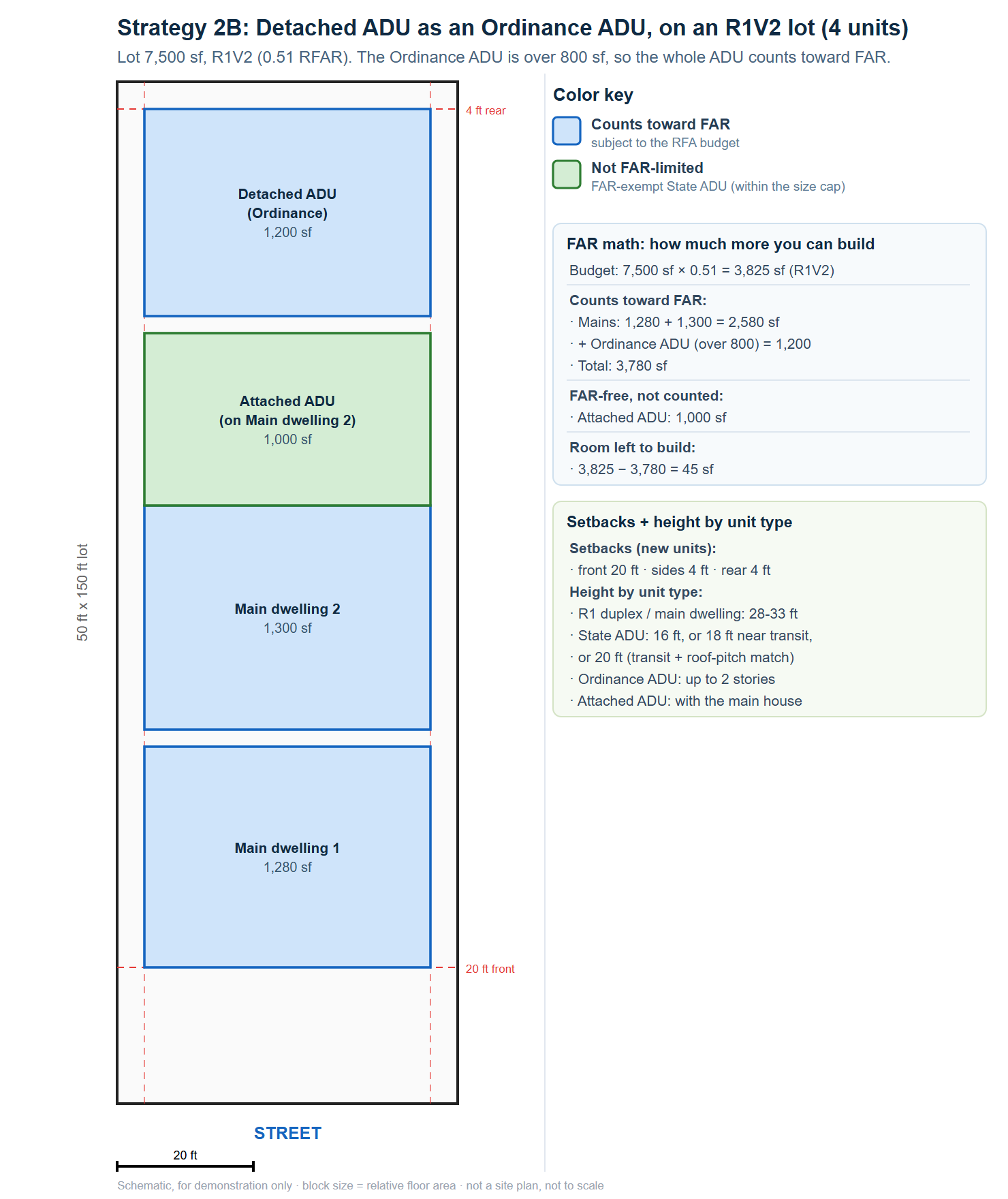
7. Strategy comparison
| Strategy 1: Duplex + 2 ADUs in back | Strategy 2: Two detached houses + attached ADU + detached ADU | |
|---|---|---|
| Units | 4 (duplex = 2, plus 2 detached ADUs) | 4 (two main dwellings, plus attached ADU + detached ADU) |
| Units at full R1 height (2–3 stories) | 2 (the duplex) | 3 (two main dwellings + the attached ADU) |
| The unlock | A duplex makes the lot multifamily, so the two back ADUs carry no FAR limit and no size limit (but they stay 16–20 ft) | Three of the four units reach full R1 height (the attached ADU does so as part of its main dwelling); only the detached ADU is capped low |
| FAR | Duplex counts; the two detached back ADUs do not (multifamily) | Both main dwellings count; attached ADU free to 1,000 sf; detached ADU free at 800 sf or fully counts as a 1,200 sf Ordinance ADU |
| Height of the rear units | 16/18/20 ft for the ADUs | Second house about 28–33 ft; the ADUs at ADU heights |
| Best for | Maximum footprint: two FAR-free back ADUs (but capped at 16–20 ft) | Maximum full-height space: 3 of the 4 units at 28–33 ft |
8. The R1 zone and its variations
Every lot here is a form of R1. A variation zone's name is a letter + a number (for example R1V2). The letter (V, F, R, H) sets where the tall mass may sit — V anywhere, F toward the front, R toward the rear, H hillside. The number (1 to 4) sets the FAR budget — 1 is the most floor area, 4 the least. The grid below is keyed by zone across the top: pick your zone's column, then read its FAR (on your lot-size row), height, the encroachment-plane origin, coverage, and where the bulk sits. An R1V2 lot is highlighted.
| Zone → | Standard R1 | R1V1 | R1V2 | R1V3 | R1V4 |
|---|---|---|---|---|---|
| FAR ratio — lot area × this = your floor-area budget (graduated by lot size) | |||||
| Lot up to 6,000 sf | 0.45 | 0.65 | 0.55 | 0.45 | 0.40 |
| 6,001 to 7,000 sf | 0.45 | 0.63 | 0.53 | 0.43 | 0.38 |
| 7,001 to 8,000 sf | 0.45 | 0.61 | 0.51 | 0.41 | 0.36 |
| 8,001 to 9,000 sf | 0.45 | 0.59 | 0.49 | 0.39 | 0.34 |
| 9,001 to 10,000 sf | 0.45 | 0.57 | 0.47 | 0.37 | 0.32 |
| Over 10,000 sf | 0.45 | 0.55 | 0.45 | 0.35 | 0.30 |
| Height & bulk — set by the zone, not the lot size | |||||
| Max height | 28 / 33 ft | 30 ft | 30 ft | 28 ft | 20 ft |
| Encroachment plane starts at | 20 ft | 22 ft | 22 ft | 20 ft | 14 ft |
| Max lot coverage | No max | 50% on small lots → 40% on big lots (R1 variation zones only) | |||
| Where the tall mass sits | one-family massing | anywhere on the lot (the V = variable-mass letter) | |||
Encroachment plane: above that origin height, a 45° plane angles in from the front/side setback, so upper floors must step back as the building rises (LAMC 12.21.1). It — not lot coverage — is the real shape limit on R1 massing.
R1F and R1R use the same FAR ratios as R1V above — they only change where the tall mass sits (R1F toward the street, R1R toward the rear) and allow about 26 ft at number 4 (vs R1V's 20 ft). R1H is hillside, with separate rules.
Your budget = lot area × the ratio. Example: a 7,500 sf lot (the 7,001–8,000 row) in R1V2 = 7,500 × 0.51 = 3,825 sf; in standard R1 = 7,500 × 0.45 = 3,375 sf.
Always confirm a parcel's exact zone and RFAR on ZIMAS. Source: CP-7150 (Jan 2026), Table 12.08 C.5(b)–(c).
9. The other standards that shape a design
Setbacks
New SB9 units and ADUs need no more than 4 ft at the side and rear. An existing main dwelling you keep retains its current setbacks. The front yard follows the underlying R1 zone (about 20 ft).
Parking
SB9 and State ADUs require zero parking within a half mile of transit (and several of these lots qualify); otherwise about one space per unit. A detached Ordinance ADU may carry a parking requirement. Tandem and uncovered spaces are allowed.
Fences and hedges
Front yard fences/hedges are limited to about 3.5 ft; side and rear to about 6 ft. A fence in the middle of the lot (between the front house and the rear units) is treated like a side/rear fence, roughly 6 ft.
Lot coverage and the encroachment plane
Standard R1 (R1-1) has no maximum lot coverage (confirmed with City Planning). The R1 variation zones (R1V/F/R) do cap coverage, graduated from about 50% on small lots to 40% on large ones. What actually limits the upper massing on R1 is the encroachment plane: a 45-degree plane that starts at a set height above the front/side setback (20 ft in standard R1; 22 / 22 / 20 / 14 ft in R1V1–R1V4) and angles in toward the lot, so the building steps back as it rises (LAMC 12.21.1). On a multifamily Strategy 1 lot, with FAR off the ADUs, the binding limits are height, the 4 ft setbacks, and the encroachment plane — not lot coverage.
Overall takeaway
- Strategy 2 is the height play: 3 of the 4 units reach full R1 height (two to three stories) — the two main dwellings plus the attached ADU riding one of them. Only the one detached ADU is capped at 16 to 20 ft. That is usually the most usable, sellable square footage. The 800 sf State ADU keeps that detached unit FAR-free; a 1,200 sf Ordinance ADU makes the whole ADU count and needs a higher-FAR variation zone.
- Strategy 1 (duplex) maximizes footprint instead. The duplex makes the lot multifamily, so the two detached back ADUs carry no FAR limit and no size limit — but they stay capped at 16 to 20 ft, so they cannot stack into the tall, multi-story space a main dwelling can.